




PCT Patent Entry into China: A Cost Lock-In Mechanism Many Applicants Overlook
There is a moment, usually around month 28 or 29 of your PCT application’s life, when your China IP strategy becomes a cost reality. The application that started as an idea — and grew through drafting, international search, and maybe some Article 19 amendments — now has to become a paid-up Chinese patent prosecution.
What many applicants find surprising is how much of that cost was already locked in by decisions made much earlier. This is what I call the cost lock-in mechanism of PCT entry into China.
What Gets Locked In at National Phase Entry
When you enter China’s national phase, CNIPA’s official fees are calculated based on the application as it stands at entry. Specifically:
1. Claim count. China charges a per-claim surcharge for every claim beyond the first ten. If your PCT application has 25 claims, you’re paying surcharges on 15 of them upfront — before a single examination action. This is calculated from the claims in your Chinese translation at the time of national phase entry.
2. Page count for specification. China’s official fee structure also includes charges based on application length above a base threshold. A long international specification — common in US and European biotech or software filings — translates to elevated fees.
3. Translation volume. Unlike most Western patent offices, CNIPA requires a complete Chinese translation of your entire application at national phase entry. The word count in your international specification drives translation costs directly. A 200-page biotech specification translated at professional patent rates is a significant line item.
4. Number of independent claims. Prosecution strategy in China often hinges on independent claims, and CNIPA’s fee structure treats them differently from dependent claims. Applicants with multiple independent claims per claim category (product + method + use) face compounded costs.
Why “Lock-In” Happens in Practice
These cost drivers are not surprising in isolation. What makes them a lock-in mechanism is that they were all set at the time your international PCT application was drafted — often 18 to 28 months before you ever think about China costs.
The original PCT drafter may have been a US firm optimizing for a large US claim set. The specification may be 150 pages because that’s what a US biotech application requires. The claims may number 30 because that’s what a US prosecution strategy demands.
None of that is wrong for the US. But entering China’s national phase with that original application, unchanged, means you’re paying for a US-optimized filing in a system with a very different fee structure.
The Three Levers You Can Still Pull
Even though costs are largely locked in by the original application, you do have options to reduce them — if you act before national phase entry.
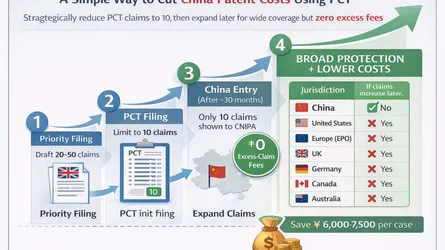
Lever 1: Amend claims before entry. Under PCT provisions and China’s national phase rules, you can amend your claim set when entering the national phase. Reducing from 25 to 10 claims before filing the Chinese translation eliminates surcharges on 15 claims from day one. Work with a China Patent Attorney to identify which claims are commercially necessary in China and which are redundant for your specific enforcement context.
Lever 2: Trim the specification. If there are entire sections of your specification that are irrelevant to your China commercial strategy — detailed manufacturing examples for processes you don’t use in China, regulatory guidance for systems not sold there — you may be able to reduce the document length without affecting claim support. This is technically sensitive work and needs expert review, but can materially reduce translation and page-count fees.
Lever 3: Time your filing carefully. CNIPA applies fee rates based on the filing date. Fee schedules are periodically updated. While this is not always a controllable variable, large multinationals with portfolios sometimes time batch filings to a known fee period.
A Cost Estimate to Make This Concrete
For a typical mechanical or hardware China Patent application entering via PCT with 20 claims and a 50-page specification, you’re typically looking at:
- Official filing fee: ~RMB 950 base
- Claim surcharges (10 claims over base × RMB 150): RMB 1,500
- Translation (50 pages × professional rate): RMB 5,000–12,000+
- Professional services (national phase formalities, claim strategy): variable
Compare that to the same application trimmed to 10 claims: the surcharge line drops to zero. Over a portfolio of 20 applications entering China in a single year, that’s a meaningful difference.
The Upstream Solution
The best time to manage China national phase costs is not at month 29. It’s at the drafting stage, when you structure your PCT application with China’s fee logic in mind.
This doesn’t mean writing a weaker patent. It means structuring claims and specifications in a way that is both strong for the US and efficient for China — not identical, but compatible.
Ready to plan your China national phase entry?
Our China Patent team works with applicants at every stage of the PCT timeline. Or speak with a China Patent Attorney to review your pending applications before the 30-month deadline.