




Two Inventors. Two Views on China Patents. One Hard Reality.
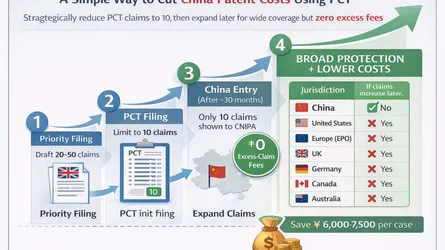
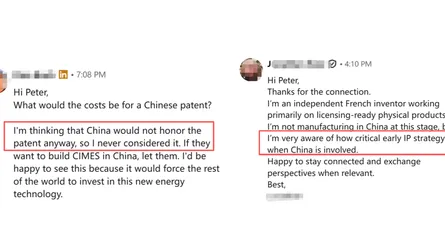
I've had this conversation more times than I can count. Two different inventors, two completely different beliefs about China, and one outcome that neither of them expected. The first inventor — call him Marco, a German engineer — came to me after his startup's sensor technology started appearing in Chinese online stores. He had never filed in China. His reasoning: "We know China is a copycat market. We focused on protecting in Europe and the US." The second inventor — call her Liu Wei, a Chinese-American founder — came to me three months before her Kickstarter launch wanting to file patents in every major jurisdiction simultaneously, including China, "just to be safe." Both of them were acting on convictions. Both of them needed a different conversation than the one they expected. The "China doesn't respect IP" myth Marco's assumption is common, and it is becoming less accurate every year. China processed over 1.5 million patent applications in a single year. Its courts are increasingly ruling in favour of foreign IP holders. Multinationals from Germany, Japan, and South Korea now rely on Chinese patent filings as a core part of their China strategy — not because they are optimistic, but because they have done the maths. When Marco's technology appeared on Taobao, his options were limited. A cease-and-desist letter from Europe meant nothing to a Shenzhen supplier. Without a Chinese patent, his leverage was near zero. The "protect everything everywhere" trap Liu Wei's instinct was the opposite — and also wrong, but for a different reason. Filing simultaneously across five jurisdictions before her invention claims were finalised would have locked in broad, untested language everywhere. In China specifically, where examiners apply strict "no new matter" rules, you cannot go back and strengthen claims after filing. I suggested she use the PCT route first, use the national phase entry window to refine her claims, and enter China when she had a clearer picture of the manufacturing landscape and the competition. The hard reality Neither extreme works. "Don't bother with China" leaves you exposed in the world's largest manufacturing hub, with no legal recourse if a supplier copies your design or a competitor files a defensive patent around your technology. "File everywhere immediately" creates a patchwork of broad, expensive, under-optimised patents that are difficult to enforce and costly to maintain. What works is strategic China Patent filing: understanding which claims need China coverage, when to file, via which route (PCT or Paris Convention direct), and what IP assets beyond patents — NNN agreements, trademarks, design registrations — form the protection perimeter. What happened to Marco and Liu Wei Marco's case was not lost. We identified a utility model filing path that, while not matching his original broad claims, established a prior art position and gave him a platform to negotiate with the Shenzhen supplier. The lesson was expensive. But it wasn't terminal. Liu Wei launched on schedule. She entered China's national phase at month 28 with a claim set refined through the PCT international phase examination. Her granted Chinese patent, when it came, was narrower than her original filing — but it was exactly the right scope for the product she had actually launched. The difference one conversation makes If you're an inventor or a startup founder approaching China with either of these two views, I'd like to offer a third: China is not a threat to be ignored, and it's not a jurisdiction to approach through fear. It's a market, a manufacturing centre, and an IP arena — one that rewards preparation and punishes assumptions. If you're unsure which view has been shaping your decisions, that's a good place to start.Ready when you are. Our China patent team can assess your situation and map out the most defensible filing path for your technology. Speak with a China patent attorney to get a direct read on where you stand.