





Type something to search...

Patent costs

Practical Answers
blog-thumb
By Peter Lin/ On 17 Dec, 2025

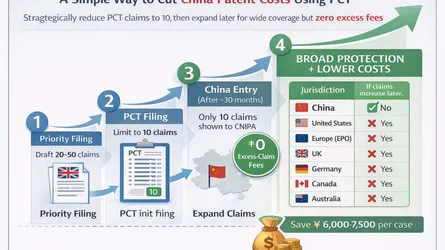
A Simple Way to Cut China Patent Costs When Using PCT — Without Giving Up Protection

Let me say something directly: most foreign companies entering China via PCT are paying more for their Chinese patents than they need to. Not because of unfair fees, and not because their technology is especially complex — but because nobody has walked them through the specific cost levers that exist in this system. This is a practical guide to those levers. Understanding Where China Patent Costs Come From Before you can cut costs intelligently, you need to know where they go. For a typical China Patent application entering via PCT, the main cost buckets are:Official CNIPA fees: Filing fees, claim surcharges, examination fees Translation fees: Chinese translation of the full specification, claims, and abstract Professional services: Attorney or agent fees for formalities, claim strategy, and prosecution management Office action responses: Costs that arise if CNIPA examiner raises objections after filingThe first three are largely determined by what you submit at national phase entry. The fourth depends on how well you handled the first three. Lever 1: Reduce Claims to 10 or Below This is the single most effective cost reduction available to most applicants, and it's often overlooked because it requires a strategic decision rather than just a procedural one. China charges an extra fee for every claim beyond the first ten. At the current CNIPA fee schedule, each additional claim costs RMB 150 extra in filing fees — and this is per claim, per application, at entry. For an application with 25 claims, that's RMB 2,250 in surcharges before prosecution even begins. Across a portfolio of 10 applications, you're looking at RMB 22,500 in preventable costs. More importantly: reducing claims forces a useful discipline. Which 10 claims actually capture what you need to protect in China? That forced prioritization almost always produces a stronger prosecution strategy. Work with a China Patent Attorney to review which claims are genuinely necessary for Chinese market protection and which are redundant or commercially irrelevant for this jurisdiction. Lever 2: Use the International Search Report to Pre-Empt Office Actions One of the underutilized advantages of PCT is that you receive an International Search Report (ISR) — typically by month 16 from your priority date — that identifies prior art relevant to your claims. Most applicants read this report once and file it away. A smarter approach: use the ISR to narrow or differentiate your claims before China national phase entry. If the ISR identified prior art that your current independent claim reads on, addressing that in your Chinese claim set before entry means you avoid the same objection being raised by a CNIPA examiner six months into prosecution — which costs you an office action response fee, attorney time, and months of delay. Pre-emptive amendment based on ISR findings is one of the clearest, lowest-cost interventions available before the 30-month deadline. Lever 3: Trim the Specification Length Where Possible China's official fees include a per-page component above a base threshold. More consequentially, translation costs are purely volume-driven. Review your international specification with a China-specific lens:Are there multiple detailed examples that describe the same embodiment with minor variations? Consolidating these reduces page count without affecting claim support. Are there sections discussing prior art in excessive detail? These may be necessary for US prosecution but add translation cost in China. Are there drawings that replicate each other with minimal difference? Each drawing page has a cost.Trimming even 20–30% of specification length can produce meaningful savings, especially for large mechanical or pharma filings where descriptions commonly run 100+ pages. Lever 4: Sequence Your Portfolio Entry Strategically If you have multiple PCT applications approaching the 30-month deadline in the same period, the sequence and grouping of national phase entries matters. Some applicants enter all applications simultaneously, paying a large lump sum of fees and translation costs in a short window. Others sequence entries across 3–6 months to smooth cash flow and allow claim review on each application before committing. More importantly: if two related applications in your portfolio cover overlapping technology, entering them simultaneously allows a single attorney review session to address both claim strategies — reducing professional fee overhead compared to treating each in isolation. What You Don't Have to Give Up The goal here is cost efficiency, not weakened protection. A 10-claim application with three tight independent claims and seven well-structured dependent claims can be more defensible in Chinese courts and licensing contexts than a sprawling 30-claim application that's never been tested. Chinese IP enforcement increasingly focuses on specific, clean claims. Clarity and focus are assets in China's court system and in licensing negotiations — not liabilities.Want a pre-entry cost review for your PCT applications? Our China Patent team provides claim strategy and cost analysis before your 30-month deadline. Speak with a China Patent Attorney today.

Practical Answers
blog-thumb
By Peter Lin/ On 12 Dec, 2025

PCT Patent Entry into China: A Cost Lock-In Mechanism Many Applicants Overlook

There is a moment, usually around month 28 or 29 of your PCT application's life, when your China IP strategy becomes a cost reality. The application that started as an idea — and grew through drafting, international search, and maybe some Article 19 amendments — now has to become a paid-up Chinese patent prosecution. What many applicants find surprising is how much of that cost was already locked in by decisions made much earlier. This is what I call the cost lock-in mechanism of PCT entry into China. What Gets Locked In at National Phase Entry When you enter China's national phase, CNIPA's official fees are calculated based on the application as it stands at entry. Specifically: 1. Claim count. China charges a per-claim surcharge for every claim beyond the first ten. If your PCT application has 25 claims, you're paying surcharges on 15 of them upfront — before a single examination action. This is calculated from the claims in your Chinese translation at the time of national phase entry. 2. Page count for specification. China's official fee structure also includes charges based on application length above a base threshold. A long international specification — common in US and European biotech or software filings — translates to elevated fees. 3. Translation volume. Unlike most Western patent offices, CNIPA requires a complete Chinese translation of your entire application at national phase entry. The word count in your international specification drives translation costs directly. A 200-page biotech specification translated at professional patent rates is a significant line item. 4. Number of independent claims. Prosecution strategy in China often hinges on independent claims, and CNIPA's fee structure treats them differently from dependent claims. Applicants with multiple independent claims per claim category (product + method + use) face compounded costs. Why "Lock-In" Happens in Practice These cost drivers are not surprising in isolation. What makes them a lock-in mechanism is that they were all set at the time your international PCT application was drafted — often 18 to 28 months before you ever think about China costs. The original PCT drafter may have been a US firm optimizing for a large US claim set. The specification may be 150 pages because that's what a US biotech application requires. The claims may number 30 because that's what a US prosecution strategy demands. None of that is wrong for the US. But entering China's national phase with that original application, unchanged, means you're paying for a US-optimized filing in a system with a very different fee structure. The Three Levers You Can Still Pull Even though costs are largely locked in by the original application, you do have options to reduce them — if you act before national phase entry. Lever 1: Amend claims before entry. Under PCT provisions and China's national phase rules, you can amend your claim set when entering the national phase. Reducing from 25 to 10 claims before filing the Chinese translation eliminates surcharges on 15 claims from day one. Work with a China Patent Attorney to identify which claims are commercially necessary in China and which are redundant for your specific enforcement context. Lever 2: Trim the specification. If there are entire sections of your specification that are irrelevant to your China commercial strategy — detailed manufacturing examples for processes you don't use in China, regulatory guidance for systems not sold there — you may be able to reduce the document length without affecting claim support. This is technically sensitive work and needs expert review, but can materially reduce translation and page-count fees. Lever 3: Time your filing carefully. CNIPA applies fee rates based on the filing date. Fee schedules are periodically updated. While this is not always a controllable variable, large multinationals with portfolios sometimes time batch filings to a known fee period. A Cost Estimate to Make This Concrete For a typical mechanical or hardware China Patent application entering via PCT with 20 claims and a 50-page specification, you're typically looking at:Official filing fee: ~RMB 950 base Claim surcharges (10 claims over base × RMB 150): RMB 1,500 Translation (50 pages × professional rate): RMB 5,000–12,000+ Professional services (national phase formalities, claim strategy): variableCompare that to the same application trimmed to 10 claims: the surcharge line drops to zero. Over a portfolio of 20 applications entering China in a single year, that's a meaningful difference. The Upstream Solution The best time to manage China national phase costs is not at month 29. It's at the drafting stage, when you structure your PCT application with China's fee logic in mind. This doesn't mean writing a weaker patent. It means structuring claims and specifications in a way that is both strong for the US and efficient for China — not identical, but compatible.Ready to plan your China national phase entry? Our China Patent team works with applicants at every stage of the PCT timeline. Or speak with a China Patent Attorney to review your pending applications before the 30-month deadline.

China IP Guides
blog-thumb
By Peter Lin/ On 05 Dec, 2025

From Idea to Income: Navigating the Chinese PCT National Phase with the Slimming Strategy

When an inventor files a PCT application, the instinct is always to go broad — claim everything you can while the window is open. That instinct is not wrong. But there's a moment, usually around month 28 or 29, when you have to make a very practical decision about China. Do you enter the Chinese national phase with your full PCT claim set — or do you slim it down first? This is a question I've helped hundreds of foreign founders and IP teams navigate. And the right answer almost always involves what I call the slimming strategy. Why China's National Phase Is Different China's China Patent system is built on a "first to file" principle, and CNIPA processes a staggering volume of applications — nearly half of all PCT national phase entries globally. That volume means the system has developed detailed, and sometimes strict, fee structures. Here's the key cost driver most applicants miss: China charges extra official fees for each claim beyond the tenth. If your PCT application entered with 25 claims, you're paying surcharges on 15 of them — before you've even had a single substantive examination. That's not the only cost lever. You're also paying for translation of your entire application into Chinese, typically at a per-character or per-word rate. A long, broad specification with dozens of unnecessary claims multiplies at every step. What the Slimming Strategy Actually Means The slimming strategy is not about giving up protection. It's about entering China with a claim set tailored to what the Chinese market actually needs to protect. Here are the three steps I walk clients through: 1. Audit your claims for China relevance. A US or EU patent may have claims covering specific regulatory contexts, component configurations, or use cases that don't exist in the Chinese market. Strip those before national phase entry. They add cost without adding value. 2. Reduce claim count to 10 or below where possible. If you can consolidate dependent claims without losing core protection, do it before filing the Chinese translation. Every claim above 10 triggers an additional fee at CNIPA. 3. Sharpen your independent claims for the Chinese enforcement context. In China, the enforceability of a patent often comes down to one or two independent claims. Make them tight, clear, and commercially relevant. Abstract claims that might survive in Europe often fail or become unenforceable in Chinese courts. The Right Time to Slim This is critical: you must make slimming amendments before or at the time of national phase entry, typically by the 30-month deadline from your priority date. Amending claims after entering national phase is possible but triggers additional examination rounds and costs. Under PCT Article 19, you can amend claims at the international phase before entering China. Use that window. Work with a China Patent Attorney who understands both Chinese patent law and the commercial context of your product. What Founders Often Get Wrong I see two common mistakes: Mistake 1: Entering with the full PCT claim set to "keep options open." This is expensive and tactically weak. You're paying to protect claims you'll likely never enforce, and bloating your specification makes Chinese examination slower and more contentious. Mistake 2: Slimming too aggressively. Some applicants, trying to cut costs, drop claims they'll later need — especially around manufacturing methods or component-level protection. If copycats are your main risk in China, you often need both product and method claims. The balance point depends on your industry, your enforcement likelihood, and your budget horizon. From Idea to Income: Why Claim Quality Beats Claim Quantity The title of this article uses the word "income" deliberately. A Chinese patent that exists on paper but is never enforced, never licensed, and never cited in a deal is not generating income — it's generating filing fees. Practically, a well-slimmed Chinese patent has immediate commercial value in three situations: Licensing negotiations. When a Chinese manufacturer or distributor is assessing whether to take a license, they want clean, narrow claims — not a sprawling set that a good lawyer can pick apart. A 10-claim application with two irrefutable independent claims is worth more in a licensing meeting than a 30-claim application that invites dispute. Investment due diligence. Foreign investors and acquirers looking at your China market position will assess your registered IP. Clear claim scope with a clean prosecution history signals that the patent was filed with enforcement in mind. Distributing exclusivity. If you want to appoint an exclusive distributor in China, a slimmed, granted patent with specific product claims gives that distributor something real to enforce against copycats. If you're approaching your 30-month deadline and haven't yet thought through your China entry strategy, that conversation needs to happen now — not after CNIPA acknowledges your filing.Need help choosing the right China patent entry strategy? Explore our China Patent services or speak with a China Patent Attorney to plan your national phase entry the right way.