





Entering China via US PPA: Don't Let These 3 Details Ruin Your Patent Strategy
The US Provisional Patent Application is one of the most useful tools in an early-stage inventor’s toolkit. For a relatively modest fee, you can lock in a filing date in the US for 12 months while you refine your design, test the market, and raise funds.
But I work with many founders who treat the PPA as a standalone decision — not as the starting gun in a global IP race. And when they later try to use that PPA as a priority basis for a China Patent filing, three specific details come back to haunt them.
Detail 1: The 12-Month Deadline Is Absolute — and It Runs from the PPA Date, Not the Non-Provisional
This is the most common confusion I encounter.
A US PPA grants you a 12-month priority window. Within those 12 months, you must file your US non-provisional application and, if you intend to pursue international protection, your PCT application — both claiming priority to the PPA.
The mistake: some founders file their non-provisional at month 11, then assume they have another 12 months to file internationally. That’s wrong. The PCT 12-month filing window runs from the PPA date, not the non-provisional date.
So if your PPA was filed on January 1, your PCT application (to eventually enter China) must be filed by December 31 of the same year — regardless of when you filed the non-provisional.
Miss the PCT deadline, and you lose Paris Convention priority from your PPA for all international applications, including China. Your China strategy doesn’t collapse entirely — you can still file later — but you lose the protection of your original filing date, meaning anything published or filed in the intervening period becomes prior art against you.
Detail 2: A Weak PPA Creates Unsupported Claims in China
US provisional applications are famously flexible. You don’t need formal claims. Many are essentially a first draft of the specification, or even a rough description with drawings attached. That’s fine for US purposes — the non-provisional can add rigor later, and the US prosecution history handles the detail.
China works differently.
When you file a Chinese patent application (through PCT national phase entry) claiming priority to your US PPA, CNIPA evaluates whether your claims are fully supported by the disclosure in the priority document. If the feature you’re trying to protect in China was not described in sufficient detail in the original PPA, you may not be able to claim it under that priority date.
In practice, what this means is:
- A vague PPA that describes a concept may not support specific product claims in China.
- Features added in the non-provisional draft that weren’t in the PPA lose the priority benefit in China even if they’re entirely consistent with the original invention.
- A claim that’s new in the PCT application — not in the PPA — has an effective China filing date equal to the PCT filing date, not the PPA date.
The fix: draft your PPA with the same rigor you’d apply to a non-provisional. This costs more upfront, but protects your priority chain all the way to China.
Detail 3: PCT Is Your Bridge — and It Has Its Own Timing Logic
The recommended route from US PPA to China Patent protection is:
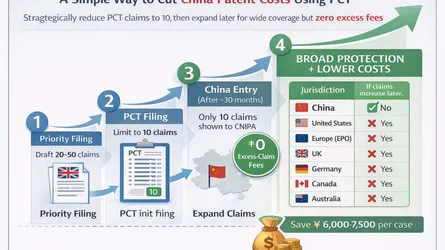
US PPA → PCT application (within 12 months of PPA) → China national phase entry (within 30 months of PPA)
This route gives you the maximum timeline: potentially 30 months from your PPA date before you commit to Chinese prosecution costs. That’s a meaningful runway for a startup.
But many founders skip the PCT step and try to file directly in China under the Paris Convention within 12 months. This is technically valid, but it creates a practical problem: you need a full Chinese translation of your complete patent application within 12 months of the PPA date. If your PPA was thin, rushed, or in early-draft form, 12 months may not be enough time to develop it into a China-ready application.
The PCT bridge solves this. File a PCT application by month 12, finalize your China strategy over the next 18 months, and enter China’s national phase by month 30 with a complete, properly translated application.
For US founders using PPAs as IP strategy, this three-step sequence is almost always the right structure. Speak with a China Patent Attorney before your PPA’s 12-month anniversary — not after.
Why These Details Matter Specifically in China
China operates on a strict first-to-file system. There is no grace period for prior disclosures (unlike the US). Any publication, product launch, or competitor filing that occurs between your PPA date and your China filing date could be counted against you — unless your priority claim is valid and your disclosure is adequate.
Getting all three details right means your original idea date is your protected date in China. Getting even one wrong means your China protection window may be much narrower than you think.
Planning a US-to-China patent strategy from a provisional application?
Our China Patent team can review your PPA and design a portfolio strategy that protects your priority chain. Speak with a China Patent Attorney before your 12-month window closes.