Type something to search...

Blog Posts

Adult product
blog-thumb
By China IP Gateway/ On 12 Dec, 2025

Adult products often get rejected for patents in China—why?

China's Patent Scene: Huge Opportunities, but Article 5 is a Hidden Minefield China's paAdult productsploding—global $50B by 2027 (Statista), with China leading manufacturing (Dongguan & Shenzhen). Yet Article 5 of the Patent Law is a silent killer, blocking grants for inventions seen as violating "social morality" or public interest. Designs saw a 15% rejection spike in 2024 due to visual cues, but utility and invention patents can stay steady if drafted right. The issue? Examiners tag products as "non-medical artificial sexual substitutes," sparking morality checks. From my examiner chats and database dives, if descriptions scream "intimate," initial reviews flop. Article content Kegel Exercises: Your "Medical Shield" to Bypass Article 5 How to flip it? Kegel exercises are your secret weapon. Developed by Dr. Arnold Kegel in the 1940s, these pelvic floor workouts help millions with incontinence, postpartum recovery, and quality of life (PubMed studies). In patents, a line like "vibration modes simulate Kegel contractions for muscle strengthening" shifts from "toy" to "health aid." Why? The 2023 guidelines say non-medical substitutes violate morals; Kegels provide real medical evidence (GB/T 14895-2010 standard), and examiners nod at that. In a case I handled, this turned a "no" into approval—but don't fake it; unsubstantiated claims risk fines. Article content patent illustration Drafting Magic: Lessons from a Smooth Success Case Drafting is the real art. Take CN223666103U, an "insertable electric massager" granted December 2025 without issues—just 10 months. It nailed it by focusing on "vibration mode indicators" over intimacy. CNIPA data shows medical-framed patents hit 85% approval in 2024, vs. 40% for pure adult ones. Here's their techniques vs. pitfalls I've fixed Article content This echoes trends: 2023 guidelines stress public acceptance—Taobao sales or Shanghai expos aren't "immoral." But controversies persist: Unproven health claims lead to rejections. Examiners aren't anti-innovation; they just need proof it's beneficial, not boundary-pushing. For Global Players: Stack US/EU Patents For global players, stack US/EU patents—USPTO's lenient on health claims, perfect for Amazon enforcement. Faced challenges in sensitive tech patents? Share below—I'd love your stories! #PatentStrategy #AdultWellness #ChinaIP #KegelInnovation #EntrepreneurJourney Key Citations: China National Intellectual Property Administration (CNIPA) Database Statista Adult Wellness Market Report PubMed on Kegel Exercises Beijing IP Court Case (2019) Jing 73 Xing Chu 3870 2023 Patent Examination Guidelines For more article, visit our Linkdedin newsletter: https://www.linkedin.com/newsletters/china-ip-gateway-7392039659566153728/

Kickstarter
blog-thumb
By China IP Gateway/ On 03 Dec, 2025

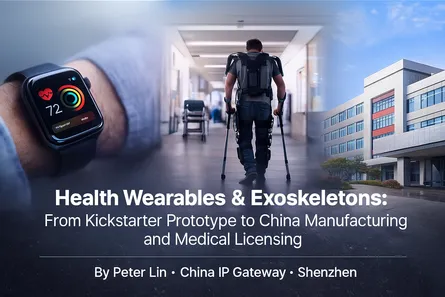
Health Wearables & Exoskeletons: From Kickstarter Prototype to China Manufacturing and Medical Licensing

What to Protect: Algorithms, Structure, and Appearance • Sensor + Gait Algorithms This is your real IP. Never over-explain the logic. Show the effect, not the “how.”• Exoskeleton / Assistive Structures Structural mechanisms (joints, linkages, load-transfer designs) are the hardest to design around. These are the best candidates for licensing later. • Industrial Design If it’s worn on the body, appearance is a selling point. Always file a design patent — it’s part of the user’s “social comfort.”Entering a Chinese Factory: Much Harder Than Kickstarter Health wearables and gait-assist devices are not regular consumer electronics. The factories are different, the requirements are different, and the risks are very real.• Small-batch prototyping is expensive Strength tests, material consistency, safety checks — the bar is high for anything that touches the human body. • Tooling ownership is a trap I’ve seen founders spend two years developing a structure, only to discover the factory considered it “joint development” and sold the same mechanism to another buyer. • ISO 13485 is not optional If you’re building anything remotely medical or assistive, the factory must have medical-grade process control. (I’ve helped overseas teams select compliant factories and helped Chinese factories pass export certification — this always becomes the bottleneck.) • Your Kickstarter prototype is not manufacturable Most health devices require DFM + second-stage engineering with the factory. This surprises every first-time founder.Commercialization: Don’t Just Sell Hardware — License the Capability The future of health hardware is not “sell devices.” It’s licenseability — especially into hospitals, rehab centers, and senior-care institutions.A. License algorithms to B2B institutions Gait analysis Posture detection Rehab training models Data dashboards Hospitals care about outcomes, not your brand size. B. License structural patents to local device makers Let local companies handle sales and regulation. You earn license fees + royalties. C. License full solutions (highest value) Hardware + software + algorithm + rehab protocol + regulatory pathway. This is where long-term revenue lives. One-Sentence Takeaway For health wearables and exoskeleton devices, the real strategy is: Protect the core → Manufacture in China → License into the medical world. Kickstarter is only your first chapter. Licensing is where the story becomes global. If you’re building a health wearable, exoskeleton, gait-assist device, or rehab product, and want help planning IP, factory entry, or licensing strategy — feel free to reach out. I’m based in Shenzhen and see these cases every week.

US Provisional patent
blog-thumb
By China IP Gateway/ On 02 Dec, 2025

🇺🇸 Provisional vs Non-Provisional Patent Applications — Which One Fits Your Kickstarter Launch?

I’m Peter Lin — over the past decade, I’ve helped creators and companies file more than 200 U.S. patent applications. One question I hear again and again — especially from Kickstarter founders — is: “Should I start with a provisional or a non-provisional patent application?” It’s a simple question with a strategic answer. Let’s break it down — from one innovator to another. ⚙️ 1. What’s the Real Difference? Provisional Application Think of it as a 12-month placeholder for your idea. You don’t need formal claims or declarations — just a clear written description and drawings. Once filed, you can label your product as “Patent Pending.” Non-Provisional Application This is the formal patent application that gets examined by the USPTO. It must include claims, drawings, and a declaration. Only after this step can your patent be granted and enforceable. 🧭 2. Which Should You Choose? Your Situation Better Option Why Still refining your prototype Provisional Cheaper, faster, buys you 12 months to improve or test market fit. Ready for full protection Non-Provisional Starts examination immediately; no need to re-file. Tight budget, early Kickstarter stage Provisional Gives you “patent pending” status to attract backers and investors. Confident in technical maturity Non-Provisional Saves time — goes straight to real examination. 💡 3. My Experience-Based Advice After reviewing hundreds of U.S. filings, here’s what I tell early inventors: File something before you go public. Even a rough draft of your invention can lock in your priority date. Use the provisional year wisely. Improve your prototype, talk to investors, validate demand — but remember to convert it into a non-provisional before the 12-month deadline. Don’t treat the provisional as “half-work.” It still needs enough technical detail to prove you actually possessed the invention. For Kickstarter projects: A provisional often makes perfect sense. It gives you credibility (“Patent Pending”) without draining your campaign funds too early. 🕓 4. The Takeaway Provisional = Speed & Flexibility Non-Provisional = Strength & Enforceability Start small, but start right. Your patent strategy should grow with your product — just like your campaign evolves from a concept video to real-world production. China IP Gateway, Peter Lin, IP之道, Intellectual Property China, Trademark Registration China, Patent Filing China, Brand Protection, OEM Risk, China Manufacturing, IP Strategy #ChinaIP #TrademarkChina #BrandProtection #IntellectualProperty #PeterLin #ChinaIPGateway #OpenPTO #IPStrategy https://www.linkedin.com/pulse/provisional-vs-non-provisional-patent-applications-which-peter-lin-ivqfc

Your Brand’s China Entry
blog-thumb
By China IP Gateway/ On 01 Dec, 2025

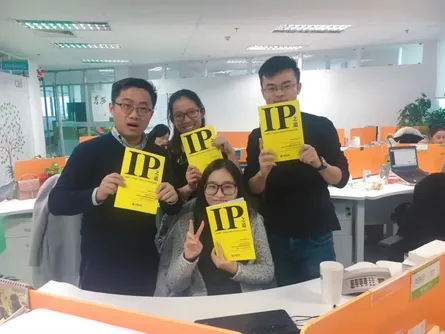
Why “IP之道” Isn’t Just a Book — It’s a Blueprint for Your Brand’s China Entry

The book explores three essential ideas: IP as Strategy, not as Shield — Treat IP as part of your business design, not just a legal backup. From Filing to Operation — Owning rights is easy; using them to drive growth is the real skill. Cross-Border Mindset — In a globalized supply chain, your rights must move with your products. At the time, many Chinese companies were learning how to expand overseas. But in recent years, I’ve noticed the opposite need emerging — foreign companies now face serious IP challenges when manufacturing in China. Article content This realization led directly to the creation of China IP Gateway. 🌏 When Global Meets Local — The Birth of China IP Gateway In the past decade, I’ve helped hundreds of international clients protect their ideas and brands in China. Again and again, I saw the same pattern repeat itself: A European electronics brand loses its trademark to a former factory partner. A US startup’s product drawings are used for a “utility model” patent by its supplier. A global brand delays its registration, only to be blocked by Customs when exporting from Shenzhen. The problems were never just legal — they were structural. Foreign brands often had great IP portfolios abroad but no defense layer inside China. Article content That’s why I founded China IP Gateway — a platform designed to turn the principles of IP之道 into real-world protection. We connect foreign innovators with China’s IP system through: Trademark registration and defense strategies Patent filing and enforcement coordination Customs IP recordal and monitoring Integrated backend tracking system powered by OpenPTO In short, China IP Gateway is where global vision meets Chinese execution. 💡 Lessons from “IP之道” in Today’s Context Writing IP之道 taught me one powerful truth: “You can’t manage what you can’t see.” Most companies fail not because they don’t care about IP, but because they don’t map it. They treat IP as a document, not as an ecosystem. At China IP Gateway, we’ve built tools to visualize that ecosystem — to let clients see their filings, timelines, and risks in one centralized dashboard. This isn’t just about convenience; it’s about clarity. When you see how your IP connects with your supply chain, your decisions become faster, safer, and smarter. 🚀 Why It Matters Now In today’s geopolitical and commercial landscape, the gap between manufacturing in China and owning in China is widening. Factories can produce faster than ever, but legal systems move on paperwork — not promises. So if your products touch China, your brand protection must too. Otherwise, you risk being the innovator who became an imitator — not because you lacked creativity, but because you lacked registration. That’s the ultimate lesson of IP之道 — and the mission of China IP Gateway. ✳️ Final Thought When I wrote IP之道, I believed that understanding IP would help companies survive the age of innovation. But after years of working on both sides of the global supply chain, I’ve learned something deeper: IP is not just about survival — it’s about sovereignty. Your designs, your brand, your story — they deserve protection in the place where they are born, built, or shipped. That’s why we created China IP Gateway — to turn that philosophy into a system. A system where international founders can protect, monitor, and grow their intellectual assets — all from one trusted platform. If your products touch China, your IP strategy should too. Visit chinaipgateway.com to see how your brand can move from theory to defense. Article content China IP Gateway, Peter Lin, IP之道, Intellectual Property China, Trademark Registration China, Patent Filing China, Brand Protection, OEM Risk, China Manufacturing, IP Strategy